

Perform
my turnRead the entire poem aloud. Expression, pace, pause, drama. Children listen, eyes up.
The complete fluency tool. A quick, accurate assessment shows you where each child is. Then everything you need to take them further: the planning, resources and pedagogy. Carry them all the way to fluent comprehension and real enjoyment.
No card. No setup. Cancel anytime.
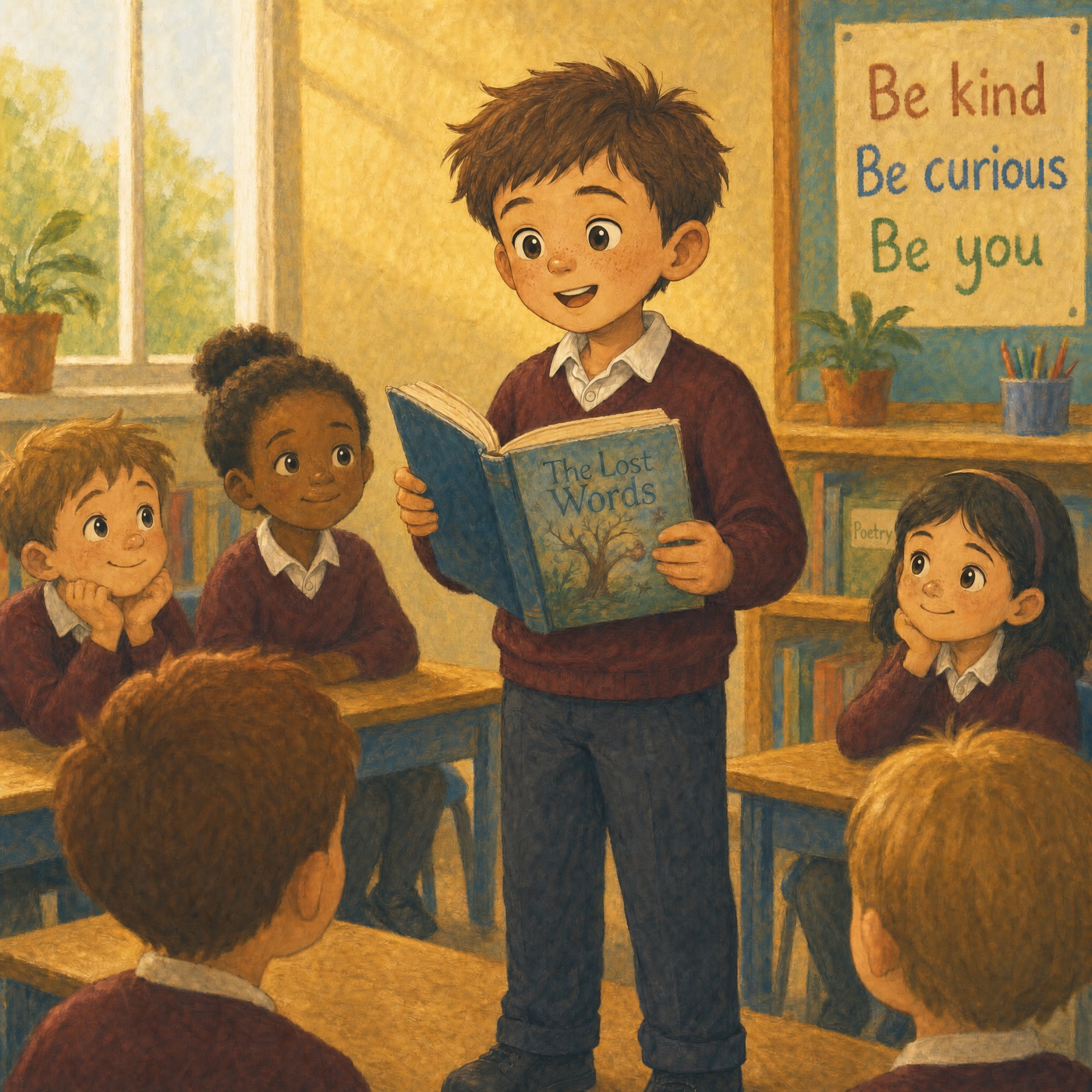
Watch the flywheel in action, 50 seconds.
“A full fluency assessment in 2 to 3 minutes per child. Less time assessing.
More time teaching.” Gareth McGovern, Assistant Headteacher

A story you’ll recognise
I want to tell you about a child. Not a dramatic one. An ordinary one, which is the whole point.
Alfie is in Year 3. He met the phonics check threshold at the end of Year 1, and Alfie can read, in the sense we usually mean it. Put a book in front of him and he’ll give it his best shot. He has secure decoding knowledge, a decent sight vocabulary. Nobody would call him a struggling reader.
But listen to him for a moment and you hear it. The effort he is exerting. He reads in little chunks, gets a run going, then trips on a word. Works hard to decode it, then gets going again. He’s working so hard at getting the words off the page that the reading never lifts. He doesn’t have the time or the cognitive space for expression.
Ask him about it afterwards and he might give you a character, maybe where they were. But what they did, why they did it, what might happen next? Gone. He was too busy reading to understand what he read.
This is Alfie.
And there are thousands of children like him.
That’s why we built ReadingFluency.
Alfie doesn’t need more reading comprehension. He needs to stop pouring all his effort into getting the words off the page, so there’s something left over to understand them. That’s what fluency does, and the flywheel is how you build it.
Assess where a child’s fluency really sits. Teach with short, joyful poem lessons. Reassess to see how far they’ve moved, what they can do now and what still needs work. And once the wheels are turning, there’s no looking back.

We’ve found Reading Fluency incredibly useful at Brambleside. It has helped us move beyond a broad sense of reading need and identify, with much greater precision, which pupils need support with fluency, pace and automaticity. The assessments are quick to use, easy to interpret and have given staff clear information to shape targeted intervention. Most importantly, it has helped us spot children who may be able to decode but are not yet reading with the fluency needed to fully access comprehension.
Simon recognised a real problem for schools: the absence of simple, accurate reading fluency assessments. By creating this tool, he has provided a solution that enables schools to identify pupils’ needs precisely and act on them. It’s something every school should have.
Step one
One unpractised passage at the child's stage, a minute or two to hear them read it, and two numbers recorded together: rate and accuracy. ReadingFluency.co.uk gives you the standardised passages for every stage and does the scoring, so the check stays quick and the picture is whole-school. The full classroom method, with the marking routine, is in our guide to how to assess reading fluency.
The quick check takes two minutes. The deeper layers are there when you want them. This demo works like the real thing, so tap through.
87 WCPM
Two minutes with a book. Not twenty with a spreadsheet.
The child reads an unpractised, year-group passage aloud for one minute. The tool counts the words, subtracts the stumbles and gives you words correct per minute, the measure of fluency that predicts comprehension better than almost anything else. Two to three minutes per child, start to finish, not the fifteen to twenty minutes a paper assessment takes, and a whole class fits inside a single lesson. No stopwatch, no tally chart, no working out.
Have a goTap a word Alfie stumbles on. Tap again to change the mark. Tap the space between two words to catch a word he added.
That’s the whole job: tap as the child reads. The timing, the error count and the score calculation happen on their own, and every assessment is saved to the pupil’s history.
The quick check is all you need to screen a class. When you want deeper information about a child, and you’re happy for it to take a little longer, add these two layers.
“Why does the creature need Maya’s help?”
A couple of quick questions straight after the read, logged beside the score. Because the point of fluency was never speed. It’s understanding.
Did it sound like reading, or like talking? Rate expression, phrasing and pace on a simple scale, the part of fluency a number can’t hold.

Automatic WPM, words correct per minute and accuracy, calculated live

Errors, omissions, self-corrections and additions, colour-coded

Curated, age-appropriate passages for Years 1 to 6
Professional reports in Excel and PDF for parents and school leaders

Every pupil’s assessment history in one place, by year group and class
Two to three minutes per child, start to finish

Optional comprehension questions and prosody ratings, for deeper data
Step two
So you’ve found Alfie. The question every teacher asks next is the honest one: what do I actually do on Monday? This is the answer, and it’s the engine of the wheel. Repeated reading, the one thing the evidence keeps pointing to, shaped into a simple weekly routine around a poem worth reading.
It sounds like the dullest thing in the world. It isn’t. Do it with a poem worth performing and the children want the next go. They land the funny line, they hold the pause, they read it like they mean it, because now they do. One longer lesson to launch it, then a few minutes a day. It fits the week you already have.
Hear it, grow it, show it. Tap a day to see the routine.
Read the entire poem aloud. Expression, pace, pause, drama. Children listen, eyes up.
What’s the poem about? What words don’t we know? Short and sharp.
Read again, children following. Make your choices explicit: “my voice went up here”. No more than three.
How would you read it? Fast or slow? Where would you pause? Which word is loudest?
Read one line, fully expressed. Children echo it back. The expression, not just the words.
Download the full routine as a printable PDFStick it on the staffroom wall.
Repeated reading is the most evidence-backed route to fluency there is, and poetry makes the repetition something children actually want to do. Rhythm, rhyme and a reason to read it again. These are original poems, written for the classroom, not pulled from an anthology, with an interactive whiteboard view, printable resources and vocabulary support built around every one.
Full collections for years one to four, with years five and six coming soon.
We’ve gone deepest where it matters most first, the fluency years. The approach grows outward from there, with more on the way.
Step three
A few weeks on, you assess Alfie again. Same quick check, a couple of minutes with a book. Only this time you can see it: the words per minute up, the stumbles fewer, and the thing that doesn’t show on a graph, a child reading with a bit of expression where there was none.
Words correct per minute, one child, three quick checks. The average gain across our schools this term: 13 WCPM.
This is the step almost everyone skips, and it’s the one that makes everything else work. Without it you’re hoping the teaching landed. With it you know. Assessment isn’t there to sit in a spreadsheet. It’s there to tell you what to do next. So you go again. A new poem, another week, another quick check. That’s how Alfie stops being a child who can read, and becomes a child who does.
This tool helps you measure and track reading fluency, the critical bridge between decoding and comprehension. Developed by practising teachers and reading specialists, it follows evidence-based assessment protocols including timed readings, accuracy tracking and error analysis.
The dyslexia-friendly interface helps every child show their true reading ability, while detailed analytics help you find specific fluency barriers and target teaching where it matters most.
Designed around DfE data protection standards. Your data stays yours.
Works with any English curriculum
Built on the science of reading
Built by British teachers. Supporting fluent, confident readers in primary schools.

I’m a serving headteacher, but English is my home ground. Before headship I was a literacy lead, and across four schools I’ve been the one who chose how to bring phonics in and make it work. I still believe in it. But I always felt the join between phonics and understanding was thinner than anyone admitted. Decoding gets a child to the words. It doesn’t carry them to the meaning. That longer journey is the part we leave too much to chance.
Here’s what I’ve come to believe. A child understands more when a text has been read aloud to them, when they’ve read it aloud themselves, and when they’ve learned to group words into phrases rather than trudging through one at a time. That’s what fluency teaches. More written comprehensions won’t build it. Reading, out loud, with expression and meaning, will.
One of my proudest moments this year was a class of Year 1s who spent a week on a single poem. By the end they performed it together, no help from me, and they held the pause before the last line so well that it properly landed. That’s the moment I’m chasing for every child. Not just accurate reading. Reading that means something to the child doing it.
So use the assessment on its own if that’s all you need. Plenty of schools do, running it every so often to keep an eye across a class. You’re under no obligation to go further. But if you feel the wheel start to turn, you’ll know what to do next.
Simon Sharp, Headteacher
For 30 days you get the whole flywheel. Open, no gates. Run it with your own children, in your own classrooms, and see what it does.
The fluency assessment, to find the gap the phonics check missed.
The poetry collections and the hear it, grow it, show it routine.
The quick re-check that shows you the movement, child by child.
The questions schools ask most, straight answers.
Give a child an unpractised passage at their stage, time one minute, count the rate and the accuracy, judge what you hear, and record both numbers together. A stage is achieved when a child hits its band minimum with 95 per cent accuracy in the same read. ReadingFluency.co.uk does the timing and the scoring for you.
A reading fluency check is a one-minute listen. A child reads an unpractised passage at their stage aloud, you count the words read correctly in sixty seconds, and you pair that rate with accuracy and a quick listen for expression. Two to three minutes per child, and it tells you whether a child is reading accurately, automatically and with meaning at their stage.
Each reading fluency assessment takes approximately two minutes per child. The child reads an unpractised, year-group-appropriate passage aloud for one minute while the teacher marks errors. The tool automatically calculates words correct per minute (WCPM) and tracks accuracy, removing the need for manual calculation. Most teachers assess an entire class within a single lesson.
ReadingFluency.co.uk measures oral reading fluency using words correct per minute (WCPM): the standard measure of reading fluency. It captures reading accuracy and automaticity, and provides space to note prosody (expression and phrasing). WCPM correlates strongly with reading comprehension, making it one of the most efficient screening tools available for UK primary schools.
Individual teachers can use ReadingFluency.co.uk for £4.99 per month or £45 per year, with a free 30-day trial. School plans start at £99 per year for schools with up to 100 pupils, £149 per year for 101-250 pupils and £199 per year for 250+ pupils. All plans include unlimited assessments, automatic WCPM calculation, progress tracking and data export. Organisation and multi-academy trust pricing is available on request.
Yes. ReadingFluency.co.uk supports the approach set out in the DfE Reading Framework and the 2026 Every Child Achieving and Thriving white paper, which announced a new statutory reading fluency test in Year 8. The National Curriculum for English expects children to develop fluency throughout Key Stage 1 and Key Stage 2, and Ofsted 2024 English subject report Telling the Story identified fluency as a gap in many schools' reading provision. Our tool helps schools screen, track and address fluency systematically from Year 1 onwards: exactly the approach the DfE, Ofsted and the National Curriculum recommend.
No. ReadingFluency.co.uk calculates WCPM automatically. The teacher simply taps or clicks each error as the child reads. The tool handles the timing, error count and score calculation, then stores results for progress tracking over time. Results export to Excel or PDF for reporting and pupil premium reviews.
Start finding the children who can decode but cannot yet read with fluency. Your first assessment takes two to three minutes.
Run your first assessment freeNo card required. Quick to set up. Cancel anytime.